Comprehensive Solutions for Well Cementing: Float Equipment and Accessories
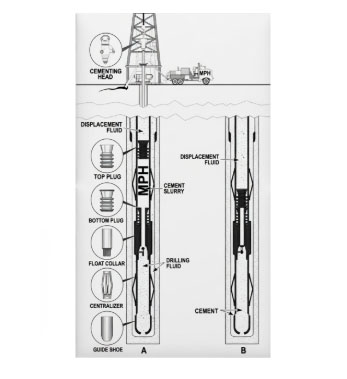
Primary cementing is one of the most critical operations in well construction, as it ensures zonal isolation, structural support for the casing string, and protection against corrosion.
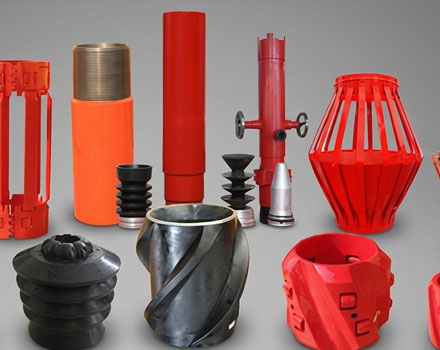
We provide a comprehensive line of high-performance Cementing Float Equipment and Accessories, engineered under API standards to withstand the most severe pressure, temperature, and abrasion conditions at the bottom of the hole.
- Cementing Head
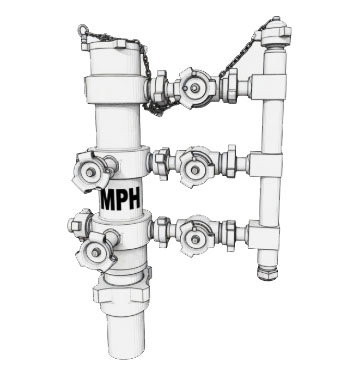
Located at the surface, the cementing head serves as the physical interface between the high-pressure pumping lines and the casing string.
- Function: It enables secure connections for the continuous pumping of fluids (mud, spacers, and cement slurries) without interrupting the operation. Additionally, it houses the cementing plugs (top and bottom plugs) internally, allowing for their precise mechanical or hydraulic release during displacement.
- Cementing Plugs (Top & Bottom Plugs)
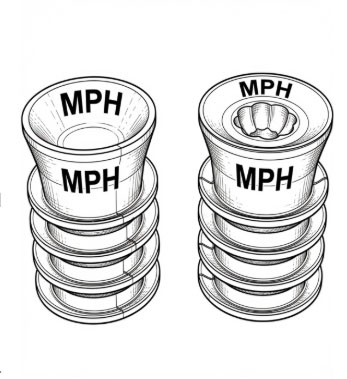
These are rubber or elastomer wipers built with a drillable core that travel through the interior of the casing to physically separate fluids.
- Bottom Plug (Typically Red): Launched ahead of the cement slurry. Its function is to wipe the inner wall of the casing and separate the cement from the drilling mud. It features an internal rupture diaphragm that bursts under pressure once the plug seats on the Float Collar, allowing the cement to pass through into the annulus.
- Top Plug (Typically Black): Launched immediately after the total volume of cement is pumped. It separates the slurry from the displacement fluid (mud or water) and wipes any residual cement adhering to the pipe. Upon reaching the Float Collar, it seats firmly onto the bottom plug, generating a pressure spike (bump pressure) that signals the completion of the operation.
- Float Collar
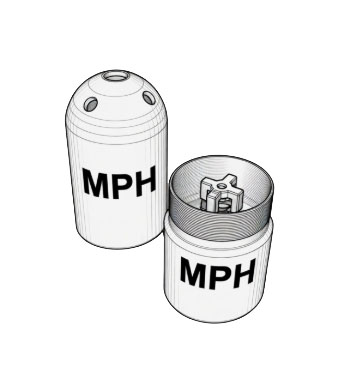
Typically installed one to three joints above the casing shoe.
- Function: It serves as the physical receptor and landing seat for the cementing plugs. It contains an internal non-return check valve (plunger or ball type) that prevents the reverse flow (backflow or U-tubing effect) of the heavy cement slurry from the annulus back into the casing once pumping ceases.
- Guide Shoe
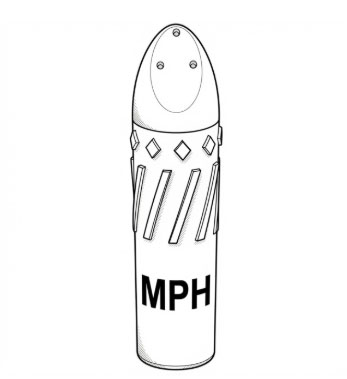
This component is threaded onto the very bottom end (the nose) of the casing string.
- Function: Its rounded outer profile, manufactured from high-strength concrete, mechanically guides the casing string through the wellbore, preventing it from getting stuck on ledges, restrictions, or formation washouts. Unlike a Float Shoe, a conventional guide shoe does not include an internal valve, allowing free fluid passage (the backflow prevention function is delegated entirely to the Float Collar).
- Centralizers
Keeping the casing perfectly centered within the open hole is indispensable for achieving a uniform cement sheath and preventing gas channeling or trapped mud pockets.
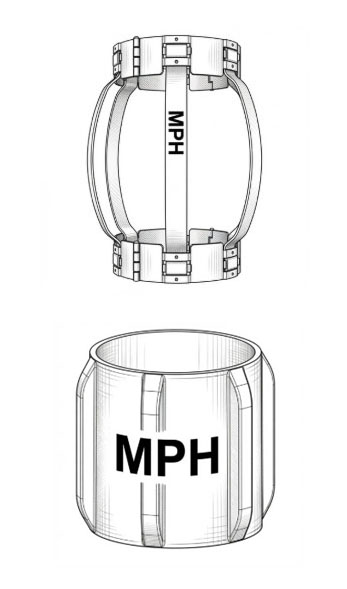
- Flexible Centralizer (Bow-Spring Centralizer): Manufactured from high-flexibility, heat-treated spring steel. These are ideal for vertical or moderately deviated wells. Their design allows them to compress when passing through tight wellbore restrictions (such as wellheads or previous casing strings) and expand with high restoring force in open-hole sections to keep the casing offset from the wellbore wall.
- Rigid Centralizer (Rigid / Solid Slip-On Centralizer): Constructed with solid blades made of steel, aluminum, or composite materials (available with or without rollers). They do not compress under load, making them indispensable in highly deviated, horizontal, or extended-reach drilling (ERD) wells, where gravitational forces are severe and a constant casing standoff must be guaranteed.